
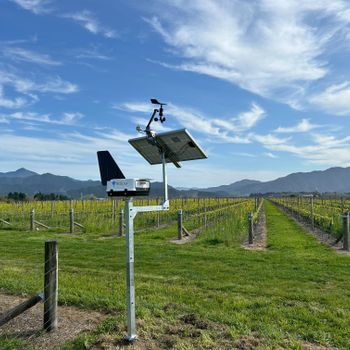
Two European specialist venture capital firms have led a $6.75 million investment round in Sydney agtech start-up BioScout.
Spun out of research at the University of Sydney, BioScout has developed in-field technology that provides growers with real-time information on crop health and disease threats. The technology’s sensors monitor more than 40 airborne threats, from crop disease spores to pollen and other particulate matter that may be harmful to growing crops.
According to BioScout, acting on early signals from its technology, rather than spraying to a fixed calendar, can cut growers’ spraying costs by up to 50%, which in high value horticulture and viticulture, can mean thousands of dollars per hectare.
The round was co-led by Demea Sustainable Investment and Astanor and supported by Australian and European institutional investors including GrainInnovate, GrainCorp Ventures, Hort Innovation Venture Fund, Artesian and Division Q.
BioScout currently operates more than 250 disease-surveillance sensors across five continents. This coverage includes a foothold in Europe which should now be quickly built upon. BioScout plans to use the new funding to significantly expand its European team and operations.
Demea partner Cyrille Cabaret said: “By enabling a reduction of up to 50% in fungicide use, we believe that BioScout’s unique technology fully addresses the challenges facing the agricultural sector, namely becoming more sustainable whilst improving farmers’ incomes.”
Astanor partner Harry Briggs added: “BioScout is one of those rare companies that solve a massive urgent problem, whilst also building a unique and powerful database that amplifies the impact. Fungal threats are the scariest threats to most farmers – yet farmers remain mostly blind to the threat until it’s too late – so they have to over-spray harmful chemicals or risk catastrophe. The BioScout team are the first to solve this hard problem with real-time spore detection.”
BioScout grew out of founder and chief executive Lewis Collins’ PhD at the University of Sydney. That was based on one idea; that most of what threatens a crop moves through the air, unseen, and if growers could see it, they could stay ahead of it.
Collins said he expects the new funding to take the company to 1,000 sensors globally by 2029.

“Crop disease doesn’t respect borders, and neither should the data that helps growers beat it,” he said. “Our mission has always been a world that can see the unseen and this raise is a major step towards it.”
Image: A BioScout detector unit.